Google AI Overviews Now Show on Half of All Searches — Is Your Site Getting Cited or Getting Buried?

Josh Conner
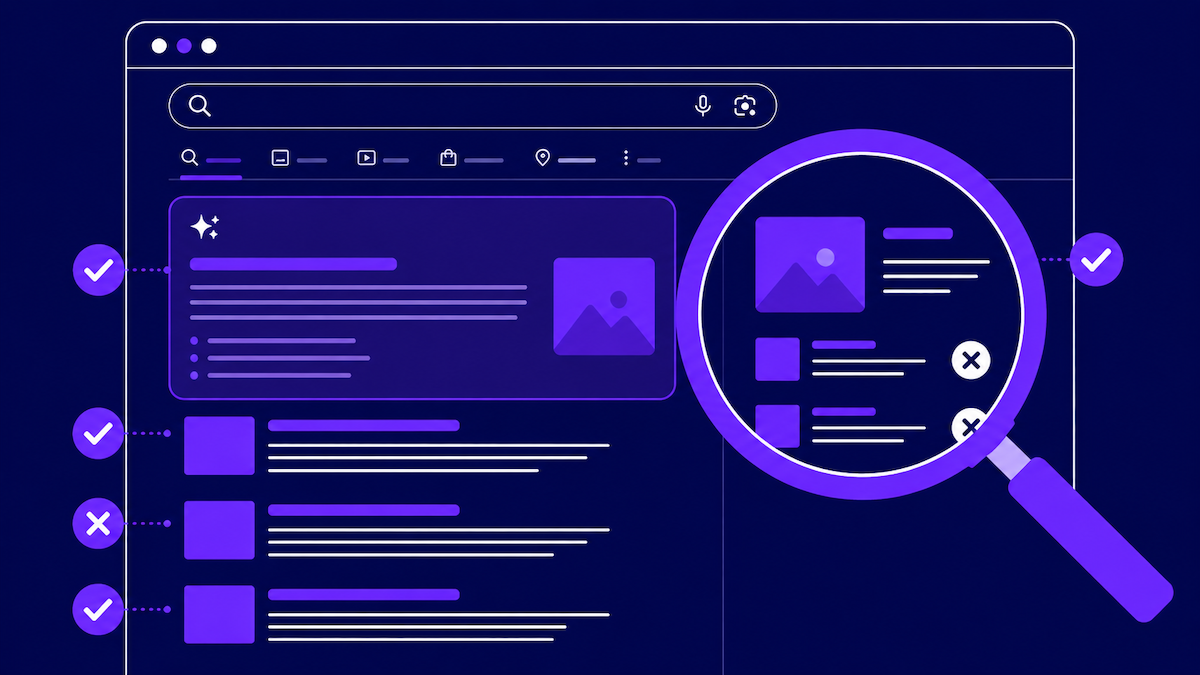
Last month we wrote about why your site might be invisible to AI search. That article covered the basics: what GEO is, why it matters, and what makes a page easier for AI systems to understand and cite.
The natural follow-up is harder: how do you know if any of it is actually working? You can clean up your headings, add schema, rewrite your service pages, and still feel like you're guessing. Traditional SEO provides rankings, impressions, clicks, and many tools that produce charts whether you ask for them or not. AI search is messier. There isn't a simple report that says, "You're being cited here, here, and here."
So we started using a practical audit process for client sites. It takes about an hour. While it won't answer every question, it gives you a much clearer picture of where you stand.
Quick numbers update
Since April, AI Overviews have shown up on roughly 50% of informational queries in the U.S., depending on the study and query set. That's a little higher than when we last wrote about this.
Organic CTR on those queries has also shifted. It reportedly hit a low point of 1.3% in December, then recovered to 2.4% by February. People may be adjusting how they use the results page. The more important point is this: brands cited inside the AI Overview tend to get more attention than brands listed below it. If your business is named in the answer, you have a real advantage. If it isn't, you're asking people to keep scrolling.
Are you even showing up?
Start with the simplest check. Most businesses skip it.
Open an incognito window and search for the kinds of questions your customers ask before they reach out. Not your company name. The actual problems. "How much does a website cost?" "Do I need a redesign, or can I update what I have?" "What's the best CMS for a small company?"
Then look closely at the AI Overview. Who is being cited? Is it you? A competitor? A national publication? An old blog post that happens to answer the question more directly than everyone else?
For clients, we usually start with ten queries. We track the query, whether an AI Overview appeared, who was cited, and what kind of page Google pulled from. Was it a service page, blog post, FAQ page, directory listing, or something else? It isn't complicated, but it is useful. In twenty minutes, you can learn more than most dashboards will tell you.
Ten searches and zero citations do not always mean you have an authority issue. Sometimes it means your content isn't structured in a way that AI systems can easily use.
Your structured data may need work
We talked about schema in the first article. This time, the question is whether the schema on your site is complete and readable. "We added schema a while back" is not the same as "Google can understand it and use it."
Paste your URLs into Google's Rich Results Test. Start with your homepage. Then check your main service pages. Then check your strongest blog posts.
Look for three things. Organization schema on the homepage, including your logo, service area, and social profiles. Many sites have a thin version that only includes the business name. FAQPage schema on service pages, especially when the page answers common buying questions. Some research has linked FAQ schema to higher AI citation rates, and in our audits, it is often one of the fastest improvements to make. Finally, check for Article schema on blog posts, with accurate dates and author information.
The Rich Results Test will show errors and warnings. Errors mean Google may not be able to read the markup properly. Warnings usually mean the markup is valid but incomplete. Start with errors. They matter most.
We find outdated or incomplete schema on client sites regularly. It's one of those quiet issues that can linger for years because nothing looks broken on the front end.
Reading your own pages like an AI would
Open your five most important service pages and read the first paragraph of each one.
Does it answer a question, or does it introduce your company?
Those are not the same thing. "We're a full-service web agency specializing in..." may be accurate, but it doesn't give an AI system much to extract. Something like "A small business website typically costs between $3,000 and $15,000 depending on scope, page count, and functionality" is much easier to cite. Research suggests AI systems pay close attention to the first 200 words of a page when deciding what to pull into an answer. If the opening is all setup and no substance, you may be making the page harder to use.
Next, look at your headings. "Our Process," "Why Choose Us," and "Our Approach" are common, but they are not very specific. They do not match how people search. A heading like "How long does a website redesign take?" gives both the reader and the search system a clearer signal.
Then count the specifics on the page. Pricing ranges, timelines, percentages, project counts, common scenarios, tradeoffs. If the page has almost no concrete details, it is probably too vague. AI answers tend to favor clear, extractable information.
The entity consistency thing nobody talks about
This one is easy to overlook. It's become more important as AI systems rely more on cross-checking information across the web.
Your website isn't the only source being evaluated. Google Business Profile, Yelp, LinkedIn, directories, social profiles, and your own footer all contribute to how clearly your business is understood. If those sources describe you in different ways, confidence can drop.
We've seen this play out in small, annoying ways. A business using one name on its website and a slightly different version on its Google Business Profile. Sounds harmless. But these systems are trying to decide whether all those references point to the same entity, and when they can't tell, they move on to a source they can verify. It cost one client citations for weeks before we caught it.
A quick check: Google your exact business name in quotes. Do the results refer to you consistently? Then compare your Google Business Profile against your website. Look at the name format, category, service descriptions, address, and phone number. Do the same for your main directory listings. This takes a few minutes and can uncover issues you wouldn't notice otherwise.
Measuring something that barely has metrics
There is no clean Google Analytics report for AI citations. Search Console doesn't have a tab that shows where you were cited in AI Overviews. The tools are still catching up, so for now you have to look for patterns.
One pattern to watch is impressions climbing while clicks stay flat in Search Console. That can mean your content is appearing in answer-style results where people see the brand or get the answer without clicking through. It's not ideal if traffic is the only goal, but it can still mean your brand is being featured.
Filter Search Console queries by terms like "how," "what," "when," "cost," and "best." If your content is becoming more visible in AI-style answers, you may see movement in those long-tail informational queries before anything dramatic in overall traffic.
Also check referral sources for perplexity.ai, chatgpt.com, and bing.com/chat. The numbers may be small. That is normal. The trend matters more than the raw count right now.
The short version
If you've got an hour:
- Search 10 customer questions in incognito and track who gets cited. (20 min)
- Run your top 5 pages through the Rich Results Test and note any errors. (15 min to check; fixing takes longer)
- Read the openings of your service pages. Do they answer real questions? Count how many concrete details each page includes. (15 min)
- Google your business name in quotes and compare the results against your Google Business Profile and directory listings. (10 min)
Most sites have a few obvious gaps once you look this way. Missing FAQ schema. Service pages that sound polished but don't answer much. Directory listings that use inconsistent names or descriptions. None of these are huge on their own, but together they make the site harder for AI systems to understand and cite.
Where this is headed
Google made changes to AI Overviews in May that seem to give local business citations more weight for some service-related searches. If you are a local or regional business with clear service pages, accurate structured data, and consistent listings, that is good news. If your site has not been touched in a while, it is a good reason to take another look.
This is still early, but the gap is starting to show. Some businesses are making their content easier to cite. Others are still publishing service pages that say things like "we deliver quality solutions" to an AI that couldn't care less.
If you ran through the audit and found gaps you're not sure how to fix, we can help. We'll run the full version and tell you what to prioritize.

EEConf 2026 Recap: What We Learned About ExpressionEngine 8 (and Everything Else) in Toronto
Just back from Toronto after spending time with the people that love using ExpressionEngine and those that build it. EE 8 is faster, ships with no known breaking changes for normal sites, and was built with AI agents in mind. Our notes from every session, with the parts that matter for your site.
Read More
Google Just Gave Every Website an AI Opt-Out Switch. Should You Flip It?
Every Search Console account now has a toggle that pulls your site out of AI Overviews and AI Mode entirely. Most small businesses should leave it alone, and the AI performance report sitting next to it is the more useful half of the change.
Read More
When Your Shared Hosting Provider Upgrades PHP and Your ExpressionEngine Site Goes Down
Your shared hosting provider quietly bumped your PHP version and now your ExpressionEngine site is throwing errors. Here's how to diagnose what broke, what typically causes it, and what your options are.
Read MoreGet a free audit
We found ourselves needing an urgent ExpressionEngine update. Thanks to Josh and his efficient intervention we were only offline for a short period of time…